Steering Committee
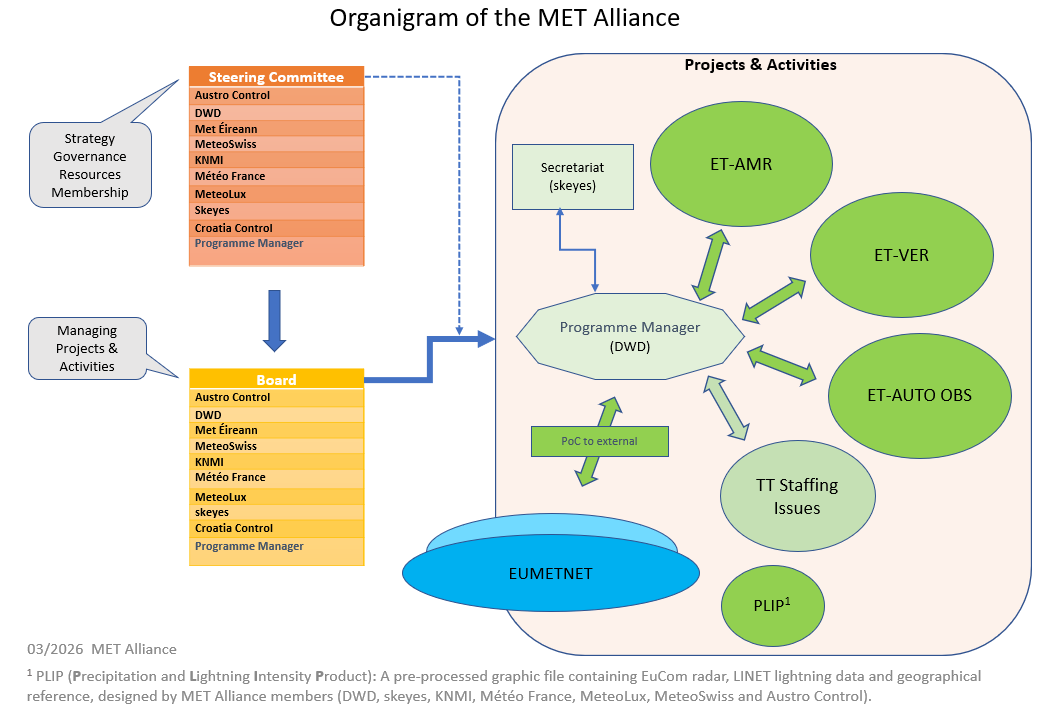
The Steering Committee (SC) governs the MET Alliance and is composed of one designated representative from each member organization. The SC decides on activities and meets at least once a year. The SC Member is usually mandated or capable of allocating resources within the Member Organization to operate within the MET Alliance collaboration.
The Steering Committee:
- agrees on the general strategy of the Board that will provide the framework for the MET Alliance Core Activities and Projects;
- decides on the MET Alliance Work Plan, budgets and the 5-year financial plan (updated annually);
- decides on all issues related to membership in the MET Alliance;
- decides on modifications to the MET Alliance Agreement; and
- approves the Annual Report of the Board.
Board
The Board manages the MET Alliance and is composed of one designated representative from each member. In collaboration with the Programme Manager / Secretariat, the Board carries out the activities of the MET Alliance. In order to achieve this, the Board is tasked with preparing the decisions of the Steering Committee and empowered to take the decisions necessary for their implementation, including the execution of agreed Core Activities and Projects within the framework of the MET Alliance Work Plan.
The Board:
- implements strategic objectives within the guidance provided by the Steering Committee;
- delivers studies or analyses requested by the Steering Committee;
- procures for the proper execution of projects and prepares relevant project descriptions or amendments to a project;
- evaluates project plans and agrees on modifications, in compliance with the guidelines and decisions of the Steering Committee;
- prepares the MET Alliance Work Plan, the related budgets and the (annual) 5-year financial plan and presents them to the Steering Committee;
- monitors the execution of projects;
- regularly reports to the Steering Committee.
The Board meets face-to-face approximately every nine months and has regular virtual meetings in between to coordinate. The Board elects a Chairperson for a period of 2 years with the possibility of re-election once for a consecutive period. Each Member has one (equal) vote.
Programme Manager
The Programme Manager (PM) is the linking pin between the Steering Committee, the Board and the MET Alliance activities. The PM is defined as a MET Alliance Project and as such fully funded by the MET Alliance Members. The PM collaborates with the Secretariat and supports the Board, the Steering Committee and the Expert Teams, also keeping an overview over the execution of MET Alliance Projects and the financial plan. The PM is responsible for the collaboration platform in Teams and for the MET Alliance website. The website www.met-alliance.com is a static website for external communication mainly aimed at providing information on the existence of the MET Alliance and its members, giving a high-level overview of strategy, objectives, activities. The PM is the contact point for questions or coordinating activities with the MET Alliance.
Currently, the Programme Manager position is located at DWD.
Secretariat
The MET Alliance Secretariat is located at the skeyes premises in Brussels, in the heart of Europe, and manages the technical aspects of the Teams collaboration platform and the MET Alliance website.
Expert Teams
An Expert Team works to address a specific challenge or to provide a continuous service such as forecast verification. The MET Alliance currently has three Expert Teams:
ET-VER
The Expert Team on Verification is responsible for the verification of TAF, TREND and MOS/TAF Guidance (leading member: Austro Control) and the production of MOS/TAF guidance (leading member: DWD). The output is provided continuously to the participating member organizations for quality monitoring and the improvement of service provision. This is the only Expert Team with several contractual agreements in place and financial renumeration from participating members.
ET-AUTO OBS
The primary objective of the Expert Team on Automated Aeronautical Meteorological Observations is the exchange of information, best practices, innovations and new ideas between MET Alliance members with regard to aeronautical meteorological observations and the evolution towards automation. This concerns in particular the (AUTO) METAR, (AUTO) Local Routine Report and (AUTO) Local Special Report – the latter are also called (AUTO) MET REPORT and (AUTO) SPECIAL. The area of interest includes sensors, algorithms and software (automated weather observation systems (AWS/AWOS)), human factors, data exchange, regulatory and legal aspects, hybrid solutions – e.g. locations switching between manual and auto depending on operations or conditions, and remote observations or supervision using cameras (non-exhaustive). The secondary objective is to create an expert network in this specific field that can be used by MET Alliance members to request and provide information and expertise at any given time.
ET-AMR
The Expert Team on Aeronautical Meteorological Regulations exchanges best practices on the interpretation of and compliance with the regulations governing meteorological service provision to aviation. This work aims to support MET Alliance members in the efficient and harmonized implementation of meteorological services for international air navigation. The current most important regulation is (EU) 2017/373 laying down common requirements for providers of air traffic management/air navigation services.
Task Teams
The difference between an Expert Team and a Task Team is the life span of the activity undertaken. While an Expert Team will operate for an extended period, e.g. to continuously verify the quality of forecasts, a Task Team is initiated to solve a particular issue or to provide an analysis of a specific situation. This is the case when an answer to a question cannot be provided instantly and requires coordination with other members and the internal organizations, for example. To have the correct focus, a Task Team operates under Terms of Reference drafted by the Board and approved by the Steering Committee. Many of the opportunities managed via a Task Team may eventually result in closure or completing a challenge, or in the initiation of a project within an Expert Team.
Associated Experts
In line with one of the core objectives of the MET Alliance – supporting and enhancing the exchange of knowledge –, non-member organizations may actively participate in Expert Teams and/or Task Teams by submitting an application and pending a decision by the Steering Committee. Associated Experts have no representation in the MET Alliance Board and/or Steering Committee and have no financial obligations towards the MET Alliance.